
HIMEDIA
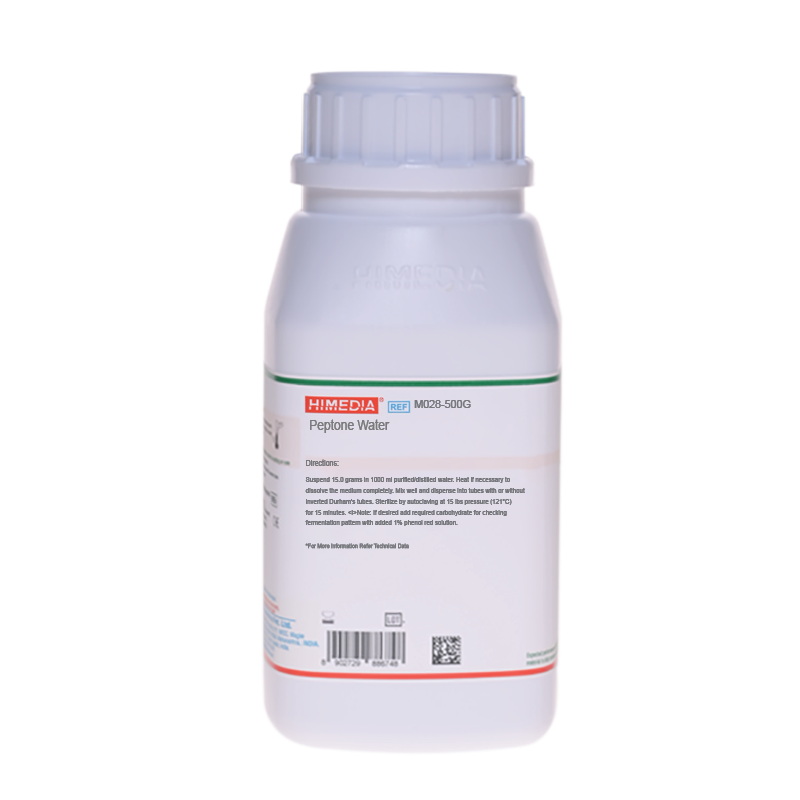
Peptone Water HIMEDIA
Peptone Water HIMEDIA
Couldn't load pickup availability
Brand: HIMEDIA
Intended Use
Peptone Water is used as a growth medium and as a base for carbohydrate fermentation media.
Composition
| Ingredients | g/L |
|---|---|
| Peptone | 10.000 |
| Sodium chloride | 5.000 |
Final pH (at 25°C): 7.2±0.2
Formula adjusted, standardized to suit performance parameters.
Directions
Suspend 15.0 grams in 1000 ml purified/distilled water. Add the test carbohydrate in desired quantity and dissolve completely. Dispense in tubes with or without inverted Durhams tubes and sterilize by autoclaving at 15 lbs pressure (121°C) for 15 minutes.
Principle And Interpretation
Peptone Water can be utilized as a base for carbohydrate fermentation studies with the addition of sugar and indicators such as bromocresol purple, phenol red or bromothymol blue. Peptone Water is also suitable as a substrate in the study of indole production. Peptone used in Peptone Water is rich in tryptophan content. Presence of indole can be demonstrated using either Kovacs or Ehlrich reagent.
Peptone Water is recommended (1,2,3) for studying the ability of an organism to ferment a specific carbohydrate which aid in differentiation of genera and species. Peptone water is formulated as per Shread, Donovan and Lee (4). Peptone Water with pH adjusted to 8.4 is suitable for the cultivation and enrichment of Vibrio species. Peptone provides nitrogenous and carbonaceous compounds, long chain amino acids, vitamins provides essential nutrients. Sodium chloride maintains the osmotic balance of the medium. To study the fermentation ability of carbohydrates, saccharose, rhamnose, salicin are generally added in 0.5% amount separately to the basal medium before or after sterilization. The acidity formed during fermentation can be detected by addition of phenol red indicator, which shows a colour change of the medium from red to yellow under acidic conditions. If desired, Durham's tube may be used to detect the gas production if produced.
Type of specimen
Isolated microorganism from clinical specimen, food, dairy and water samples.
Specimen Collection and Handling
For clinical samples follow appropriate techniques for handling specimens as per established guidelines (5,6). For food and dairy samples, follow appropriate techniques for sample collection and processing as per guidelines (7,8,9). For water samples, follow appropriate techniques for sample collection, processing as per guidelines and local standards (10). After use, contaminated materials must be sterilized by autoclaving before discarding.
Warning and Precautions
In Vitro diagnostic use. For professional use only. Read the label before opening the container. Wear protective gloves/protective clothing/eye protection/face protection. Follow good microbiological lab practices while handling clinical specimens and culture. Standard precautions as per established guidelines should be followed while handling clinical specimens. Safety guidelines may be referred in individual safety data sheets.
Limitations
- Due to nutritional variations, some strains may show poor growth.
- Further serological and biochemical tests should be carried out on pure colony for complete identification.
Performance and Evaluation
Performance of the medium is expected when used as per the direction on the label within the expiry period when stored at recommended temperature.
Quality Control
Appearance: Cream to yellow homogeneous free flowing powder
Colour and Clarity of prepared medium: Light amber coloured clear solution without any precipitate
Reaction: Reaction of 1.5% w/v aqueous solution at 25°C. pH: 7.2±0.2
pH: 7.00-7.40
Cultural Response: Cultural characteristics observed after an incubation at 35-37°C for 18-24 hours.
| Organism | Inoculum (CFU) | Growth | Indole test |
|---|---|---|---|
| Staphylococcus aureus subsp. aureus ATCC 25923 (00034*) | 50-100 | luxuriant | negative reaction, no red ring at the interface of the medium on addition of Kovac's reagent (R008) |
| Escherichia coli ATCC 25922 (00013*) | 50-100 | luxuriant | positive reaction, red ring at the interface of the medium on addition of Kovac's reagent (R008) |
| Salmonella Typhimurium ATCC 14028 (00031*) | 50-100 | luxuriant | negative reaction, no red ring atthe interface of the medium on addition of Kovac's reagent (R008) |
Key: (*) Corresponding WDCM numbers.
Storage and Shelf Life
Store between 10-30°C in a tightly closed container and the prepared medium at 15-30°C. Use before expiry date on the label. On opening, product should be properly stored dry, after tightly capping the bottle in order to prevent lump formation due to the hygroscopic nature of the product. Improper storage of the product may lead to lump formation. Store in dry ventilated area protected from extremes of temperature and sources of ignition Seal the container tightly after use. Product performance is best if used within stated expiry period.
Disposal
User must ensure safe disposal by autoclaving and/or incineration of used or unusable preparations of this product. Follow established laboratory procedures in disposing of infectious materials and material that comes into contact with clinical sample must be decontaminated and disposed of in accordance with current laboratory techniques (5,6).
Share